Join
 Donate
The American Musicological Society is pleased to announce the recipients of the American Musicological Society’s 2026 awards and prizes. We congratulate the recipients and thank them for their extraordinary work!
Alfred Einstein Award
Morton Wan
“Silver, Timber, and Labor: Three Short Stories around the First Made-In-China Piano” Keyboard Perspectives 15 (2024–2025)
“. . .Among the fifty submissions in this year’s Alfred Einstein Award competition, the winning article explores the place of musical instrument manufacturing in an interconnected world. It is a world in which the outsourcing of labor, environmental sustainability, and economic and political tensions between the China and the West have become increasingly pressing global concerns. The subject of this article is not contemporary, but its concerns and lessons are. This is the story—actually, a set of interconnected ones—of the rise of a Shanghai-based piano maker starting in the mid-nineteenth century, told in ‘Silver, Timber, and Labor: Three Short Stories around the First Made-In-China Piano,’ written by Morton Wan and published in Keyboard Perspectives. Meticulously researched, stylishly written, and continuously insightful, ‘Silver, Timber, and Labor’ constructively complicates our understanding of global music history and, to quote the author, powerfully demonstrates ‘what music history can offer to current conversations about global capitalism.’”

AMS Teaching Award
Colleen Renihan, John Spilker-Beed, and Trudi Wright, Sound Pedagogy: Radical Care in Music (University of Illinois Press, 2024)
“. . .Sound Pedagogy: Radical Care in Music is an innovative collection of essays challenging pedagogues to reimagine their learning spaces around care, equity, and social justice. With radical care as its framework, the collection traces a trajectory from the curriculum, then outward to our musical communities, then back inward to the self. The authors, representing a diversity of musical traditions, classrooms, institutional contexts, community spaces, and approaches, seek to reshape music history pedagogy beyond the traditional art music curriculum and inspire new approaches through interdisciplinarity and critical engagement. Topics range from race and empathy through music, inclusive classrooms, community-engaged learning, public musicology, first-generation students, and mental health. As a whole, Sound Pedagogy transforms musicology pedagogy by re-centering our students and ourselves in our curriculum and beyond.”

AMS Teaching Award
Daniel Barolsky and Trudi Wright, Open Access Musicology, vol. 3 (Lever Press, 2025)
“. . .The third volume of Open Access Musicology introduces undergraduate students to contemporary musicological approaches across varied musical traditions. The collection reflects a diversity of topics, such as forensic musicology as music criticism, jazz, popular music, and Indian classical music. Written in an engaging and accessible manner for undergraduate music history classes, the authors discuss music through lenses such as Marxist thought, ethics, and race, and pose questions such as whether we should perform certain music, when music should be considered work, and what it means to be a composer. Together, the essays in the collection provide instructors with timely materials relevant to contemporary society that can supplement and broaden existing course material.”

Claude V. Palisca Award
Colin Roust
Francis Johnson – Complete Works (A-R Editions, 2025)
“. . .The Claude V. Palisca Award Committee has selected Francis Johnson – Complete Works, edited by Colin Roust (A-R Editions), as this year’s recipient of the Claude V. Palisca Award. This edition rose to the top of a field that contained a number of impressive submissions. We were most impressed by the outstanding quality of the research this edition represents, its effective presentation of the music, and the history it illuminates. We regard it as a particularly important contribution to the discipline, which makes available a body of music that is of real importance and with it a genre that has been almost invisible.”

Early Music Award
Jesse Rodin
The Art of Counterpoint from Du Fay to Josquin (Cambridge University Press, 2025)
“. . .It is engagingly written, showing deep knowledge of the music from years of study and performance. The book’s main argument is that composers in the fifteenth century developed various strategies for controlling musical energy across long time spans. How music unfolds in time—and to how it elicits responses from listeners—motivates historical and analytical insights drawn from Rodin’s vast knowledge of the repertory. The book is no less deeply engaged with a central thread from the theoretical literature on fifteenth-century music: Johannes Tinctoris’s famous (but enigmatic) notion of ‘varietas’. Rodin is by no means the first to seize upon the term. But we were deeply impressed by the clever and revealing ways he re-examines it, pouring over both what Tinctoris did and did not quite say, and how his thoughts on the topic might apply to a wide range of music (over time and genre). He also usefully breaks things down to reveal different hierarchical levels at which such varietas might operate, with lots of insights about ranges, meter, pace, direction and segmentation along the way. The book, in short, shows us new ways to read, to sing, and to listen. It merits our highest commendation.”

H. Colin Slim Award
Emily Dolan
“In Search of Panpipes, or the Limits of Materiality” Journal of the American Musicological Society 78:1 (2025)
“. . .A virtuosic exemplar of critical organology, Emily Dolan’s ‘In Search of Panpipes, or the Limits of Materiality,’ explores the labyrinthian origins and hushed legacy of an instrument that circulates in so many manifestations and contexts as to be simultaneously strangely ubiquitous as well as invisible and inaudible, pointing to occasions where, as she writes, ‘materiality falls short or becomes something else, even its opposite.’ While Dolan pirouettes imaginatively around ‘the boundaries between the material and immaterial,’ her unexpected, fascinating turns leave us wondering on her next step as she comments fleetingly on our possible perception. Starting from the 1801 sandstone figures of Papageno and his children on Schikaneder’s Theater an der Wien–and the question ‘why does Papageno play panpipes?’–she amasses a remarkable range of primary evidence and secondary literature around such objects, from tools to luring birds, to panpipes from the South Pacific, to the opera stage. Through writing that is engaging, playful, and at times laugh-out-loud-funny, Dolan gives us tools for re-considering those seemingly more substantial instruments that surround us and musicological work itself.”

H. Robert Cohen/ RIPM Award
Clifton Boyd
“‘Le facce nere del festival’: Black Musicians at Sanremo in the 1960s” California Italian Studies 14:1 (2025)
“. . .Published in October 2025 in California Italian Studies, the article is an imaginative, deeply researched, and engagingly written study of racial politics at the Sanremo Music Festival. Focus falls on the transformation of canzone italiana styles and genres thanks to the participation of Black musicians in the Sanremo gatherings. Boyd demonstrates how nonwhite singers were othered by white, Italian audiences and critics, then borrowed from, and then (ambivalently) embraced within an expanded, post-fascist-era definition of “the Italian.” Boyd combed through La Stampa, Corriere della Sera, l’Unità, Radiocorriere TV, Oggi, Ciao Amici, and Sorrisi e Canzoni TV for his findings on the ‘love and theft of Black musicality’; he compiled charts on record sales, festival winners and also-rans; and he compared and contrasted ‘Italian-foreigner’ performances of the same songs for examples of “cultural reimagining.” The article is a tour de force, moving from the microcosm of Dionne Warwick’s appearances at the festival to the reception of American popular musics globally..”

Judy Tsou Critical Race Studies Award
Andrew Berish
Hating Jazz: A History of Its Disparagement, Mockery, and Other Forms of Abuse (University of Chicago Press, 2025)
“. . .Andrew Berish’s Hating Jazz makes a landmark contribution to our understanding of how race intersects with affect, music, and history. Although the topic of jazz hatred in music literature about race and racism in the United States seems well-worn, Berish charts new ground by telling the story from the perspective of affect. A love letter to the genre, Hating Jazz draws from a vast archive and repertoire of racialized affect—including forms of mockery, disgust, contempt, and even self-deprecating humor coming from the jazz community itself—to demonstrate how the dialectics of jazz loving and jazz hating have shaped the history of the genre itself but also its aesthetics, politics, and ethics. Intensely interdisciplinary and written with care, Hating Jazz constitutes, in the committee’s opinion, an important model for our current post-2020 disciplinary moment, offering a passionate and affectively attuned response to a time that demands serious engagement with the emotion concept of hate in all its modalities.”

Lewis Lockwood Award
Abigail Fine
The Composer Embalmed: Relic Culture from Piety to Kitsch (University of Chicago Press, 2025)
“. . . Rising out of a group of 30 new books by early-career musicologists, our committee has unanimously chosen to receive the 2026 Lewis Lockwood Award, Abigail Fine’s The Composer Embalmed: Relic Culture from Piety to Kitsch. Written with rare narrative clarity and wit, Fine revisits 19th-century Austro-German musical tradition from a highly original angle, showing how ‘relic culture’ was fueled by anxiety about its own history of vulgar collecting. Evidenced in the preservation of body parts, objects, medical discourse, visual culture, Fine masterfully explains how commodifying and commercial activity encouraged by such relic culture draped itself in the language of the sacred. The book offers rich and intriguing iconography and offers an excellent example of how musicology can engage productively with the material and cultural turns that have reshaped the humanities at large. The writing is lively, accessible, and consistently engaging, the argument is both interesting and compelling, and the archive is clearly defined and thoughtfully handled. Overall, the committee was highly impressed by this book, finding it to be a compelling, original, and extremely well-written, making a focused and meaningful intervention.”

Music in American Culture Award
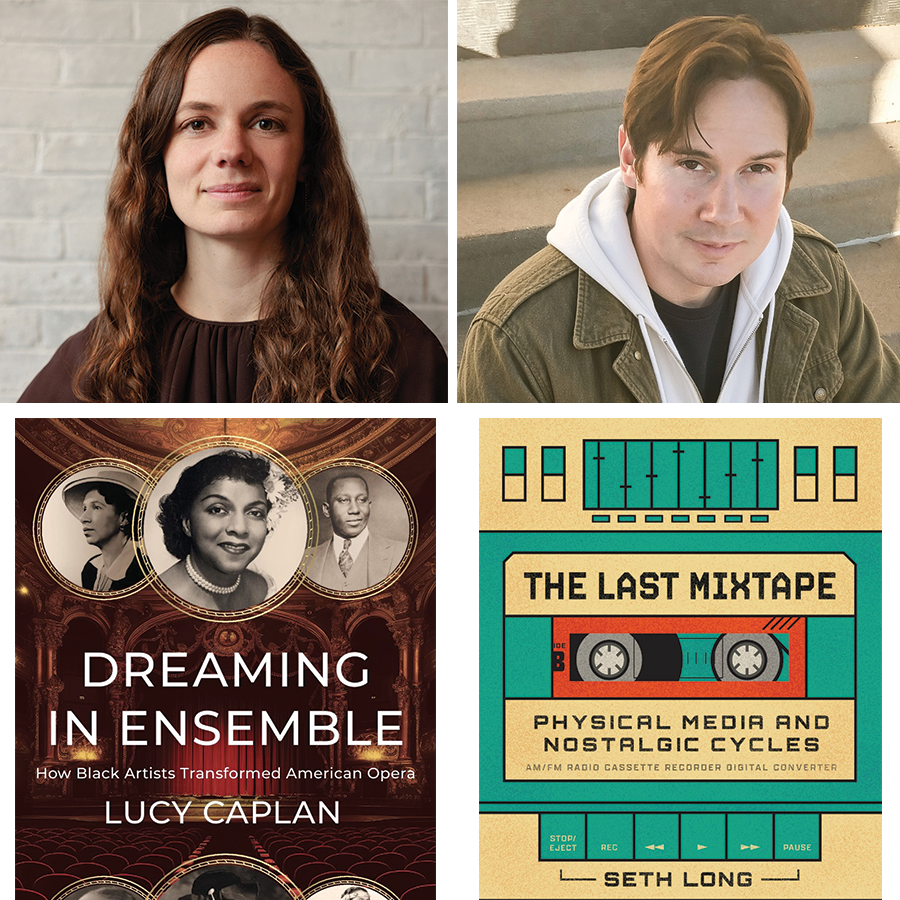
Lucy Caplan, Dreaming in Ensemble: How Black Artists Transformed American Opera (Harvard University Press, 2025)
Seth Long, The Last Mixtape: Physical Media and Nostalgic Cycles (University of Chicago Press, 2025)
“. . .These are both sweeping, ambitious books. They traverse several decades’ worth of history while probing the trajectories of a genre (opera) during the early-to-mid-twentieth century and a medium (the mixtape) during the mid-to-late twentieth century and into the twenty-first century. The arguments built by Caplan and Long make this scope feel earned and justified. These are books that fundamentally shift how we understand their respective topics, and we expect that both will become essential reading for years to come.
At the same time, however, a wonderful quality shared by these books is the space they reserve for intimate moments in the midst of a grander narrative, moments of close attention to detail. In Dreaming in Ensemble, such moments include accounts of world premiere performances, analyses of operatic passages, and portraits of individual musicians. The empathy Caplan brings to the latter is palpable, and fitting given the book’s emphasis on collaboration; Dreaming in Ensemble should draw renewed attention to many Black performers and composers whose achievements have been overlooked. In The Last Mixtape, meanwhile, Long takes advantage of the inherently personal nature of mixtape culture to present compelling accounts of mixtapes both real and—in the case of an analysis of the novel and film High Fidelity—fictional. Both authors demonstrate an impressive ability to transition seamlessly between these moments and discussions of broader cultural, historical, and sociopolitical themes. The claims they make are that much more convincing thanks to the words they devote to close readings of their materials.
The purpose of the Music in American Culture Award is to recognize “the best writing on music in American culture,” and so we must also call attention to the engaging writing found within these two books. To say that these books are well-researched would be an understatement; both make use of a dizzying array of primary sources (many of which, it must be said, are beautifully reproduced in photographs). Yet neither ever feels weighed down by those sources. Long’s style is conversational while Caplan adopts a more formal tone, each matching the tone of their respective subject. What these authors share, though, is prose of elegance, clarity, and force.
It is no exaggeration to say that no history of media in America is complete without The Last Mixtape and that no history of opera in America is complete without Dreaming in Ensemble. We commend Lucy Caplan and Seth Long for their accomplishments and heartily recommend these two books.”
Otto Kinkeldey Award
Ronald Radano
Alive in the Sound: Black Music as Counterhistory (Duke University Press, 2025)
“The Otto Kinkledey Award Committee has selected as the 2026 recipient of the award Ronald Radano’s book Alive in the Sound: Black Music as Counterhistory, an ambitious, intellectually wide-ranging, sophisticated survey of Black Music and its paradoxes of commodification and creativity from the late antebellum period through the late twentieth-century. Engaging with thinkers from W. E. B. Du Bois to Amiri Baraka, Alive in the Sound offers an impassioned argument for the exceptional nature–the aliveness–of Black Music. As Radano also writes, “Black music reveals in its double form a contrary manifestation of America, a counterhistory materialized in sound that repeats as a primary truth the nation’s unresolved conditions of race.” The book explores chronologically what Radano further analyses as the “contrapuntal cultural production of Black music as an impure pure form composed in the negative.” Alive in the Sound is richly researched and closely argued. It is sure to stimulate lively debate and discussion about the presence of Black music in American culture (and worldwide) for a long time to come.”

Philip Brett Award
M. Myrta Leslie Santana
Transforismo: Performing Trans/Queer Cuba (University of Michigan Press, 2025)
“. . .Taking a ‘sideways approach to music,’ M. Myrta Leslie Santana’s Transformismo compellingly considers how trans/queer drag performers and performance narrate and navigate racial, sexual, and economic marginality in Cuba. Santana’s intimate and powerful ethnography of trans/queer nightlife in Cuba addresses important questions about labor which have long been dormant in drag studies. The book investigates how performance and positionality are structured by the demands of capital and music as a workplace, from the role of Black femme creative praxis in navigating racialized and gendered labor to the complex (in/ex)clusion of drag kings and the limited support they receive within the scene. Transformismo is a thoroughly engaging book about communities on the margins (across multiple planes and formations), and how trans/queer musical performers in Cuba envision and enact alternative world making possibilities.”

Robert M. Stevenson Award
Laura Fahrenkrog Cianelli
Musical Practices and Mobility in Asunción (Lexington Books, 2025)
“. . .Laura Fahrenkrog Cianelli’s Musical Practices and Mobility in Asunción makes a deeply original contribution to the social history of music in colonial Paraguay and offers the first sustained study of the subject. Working against the scarcity of written musical sources and the dominance of narratives centered on cathedrals and Jesuit missions, the book reconstructs the urban musical world of Asunción and its connections to surrounding rural centers. Drawing on exceptionally thorough archival research in Asunción, Seville, and Buenos Aires, Fahrenkrog Cianelli traces the movements of Indigenous and Afro-descendant musicians, instruments, and labor across the city and the pueblos de indios. The committee was especially impressed by the book’s demonstration that spatial mobility—shaped by geography, labor demands, and yerba mate production—was central to musical life, and that urban performance practices were sustained by Indigenous and Afro-descendant musicians rather than Spanish musicians. By reversing conventional center–periphery assumptions, the book offers a rich new account of music, society, and colonial power on the margins of the Spanish Empire.”

Roland Jackson Award
L. Poundie Burstein
“’—Where is your Mother?’ and Other Astonishing Ellipse” Journal of Music Theory 69:1 (2025)
“. . .In this admirably clear and persuasive account, L. Poundie Burstein examines striking moments of harmonic and formal incoherence in Classical keyboard and chamber works. His virtuosic analyses are original not only in their marshalling of hypothetical alternatives, but also in relating such compositional discontinuities to analogous rhetorical devices in literature. In contrast to some earlier scholars who have written on these issues, Burstein argues that one should not overwrite such anomalies for the sake of asserting some larger-scale coherence, especially when doing so misrepresents the composer’s evident aims. The committee especially admired the clarity, elegance and carefully considered detail of the article’s many musical examples and figures. In his capstone analysis, Burstein convincingly suggests that external circumstances played a part in the formal design of Beethoven’s ‘Lebewohl’ Sonata (1809/10).”

Paul A. Pisk Prize (2025 AMS Annual Meeting)
Simon Frisch
“Sounding Sovereignty: Occasional Motets in the Early Modern Transition”
“. . .This paper offers a new perspective on a long-discussed repertory, pushing against the notion of ‘state’ or ‘occasional motet’ as the primary generic marker for a body of works associated with the French court prior to 1535. By drawing on an impressive array of musical, iconographic, and archival sources, Frisch re-examines widely accepted assumptions about the performance contexts of three case studies (by Jean Mouton, Jean Richafort, and Mathieu Gascogne), convincingly arguing that these motets were conceived for devotional and semi-private settings rather than for civic rituals.”

Paul A. Pisk Prize (2025 AMS Annual Meeting)
Matthew Gilbert
“Where ‘Songs Old Men Have Sung’ Were Sung: Robert W. Gordon and the Origins of California Folk Song”
“. . .The paper provides a compelling and wide-ranging historiographical contribution on the discursive construction of the idea of the ‘American Folksong.’ By examining Robert W. Gordon’s overlooked collection of folksongs and how it is steeped in a fundamentally multicultural conception of the American ‘folk,’ this study is an exercise in de-essentializing the very notion of ‘folk song,’ skillfully blending local (Californian) and global perspectives to deconstruct the Eurocentric conceptual lineage that, from Johann Gottfried Herder to Antonín Dvořák and Francis Child, has overpowered alternative narratives of the genre.”

Ruth A. Solie Award
Emily Dolan, Emily MacGregor, and Arman Schwartz
Sonic Circulations: Music, Modernism, and the Politics of Knowledge (University of Pennsylvania Press, 2025)
“. . .This volume explores the circulation of music as it flowed along and was transformed by vectors of technological and scientific innovation in the early twentieth century. Probing the contradictions between sound as a fleeting, temporal phenomenon and its lasting impact on politics, social systems, race, and imperialism, the volume’s preface, introduction, ten chapters, and two epilogues consider sonic discourses and practices in relation to contemporary work in anthropology, sociology, psychology, ethnography, linguistics, and eugenics. With case studies rooted in Europe and the United States, the volume interrogates these geographic borders to show how sound circulated globally even as it contributed to the forging of Western identity and renewed imperial ambitions. While each contribution to the volume is distinct and novel, the editorial team frames and stitches them all together to form a coherent whole, building the argument piece by piece. Meticulously edited and beautifully presented, Sonic Circulations represents a compelling intervention that will leave a lasting impact on music studies and far beyond.”

Related News