Join
Join  Donate
 The AMS is pleased to announce the 2026 cohort of Suzanne G. Cusick Professional Development Fund grantees. The Cusick Fund provides professional development and career support grants for scholars of music, sound studies, and musical performance. These grants are intended to support independent scholars, contingent faculty, and individuals whose paid work outside the academy does not offer them access to professional development. Congratulations to the recipients!
Erin Fitzpatrick
Erin Fitzpatrick, PhD, is a musicologist, songwriter, and recording artist whose career integrates popular music scholarship with creative practice. She earned her doctorate in musicology from UCLA in 2025. Her autoethnographic, practice-based research applies interdisciplinary methods from queer theory, performance studies, affect theory, critical organology, and more to explore how queer rock and pop musicians apply musical technologies to articulate and embody their distinct subjectivities and challenge conventional understandings of the meanings, uses, and structures of instruments. Erin’s work celebrates the creative strategies and innovations of marginalized artists, past and present, and encourages the questioning and reevaluation of hegemonic standards of virtuosity. In her musical career, she has released two self-produced albums with the indie label Carpark Records. Currently, she is on the faculty of the Popular Music Conservatory at the Orange County School of the Arts, where she teaches songwriting, artist development, and popular music performance and history.
Fitzpatrick’s project, Playing Like a Girl: Queer Women and the Electric Guitar, takes an autoethnographic approach to examining the dynamic interplay between queer, female musicians and the electric guitar, deconstructing the instrument’s material, cultural, and performative dimensions. By centering embodied experiences and innovative analytical frameworks, the work challenges the instrument’s historical orientation toward cisgender, heterosexual men and reframes it as a mutable tool for diverse expressions of identity, desire, and creativity. The work’s primary goal is to show how the performance practices of queer women facilitate a more inclusive and dynamic understanding of the instrument for everybody.

Daniel Jordan
Daniel Jordan is an Instructor of Musicology at the Faculty of Music, University of Toronto. His research examines the relationship between music, aesthetics, and cultural policy from 1945 to the present, with a focus on Canada, Latvia, Ukraine, and Spain.
He received a PhD in Music from the University of Cambridge, a Master of Music in Piano Performance with Distinction from the Royal College of Music in London, and a Bachelor of Music in Piano Performance with Distinction from the University of Victoria.
Jordan is the author of Coros y Danzas: Folk Music and Spanish Nationalism in the Early Franco Regime, 1939–1953 (Oxford University Press, 2023). His scholarship has appeared in journals such as Musical Quarterly and Music & Letters, with additional reviews in Intersections and Revue de musicologie.
He presents regularly at meetings of the American Musicological Society and continues to perform as a pianist alongside his academic work.
Jordan’s current research project, “The Price of Culture: Money and Meaning in Contemporary Music and Art,” examines how cultural institutions shape artistic value through commissioning practices and funding structures. Focusing on New York, Toronto, and Madrid, the study compares three models of cultural support: philanthropy-driven systems in the United States, public arts funding in Canada, and hybrid public-private patronage in Spain. Case studies of music and visual art commissions show how composers, artists, curators, and funders influence aesthetic decisions and interpretation. The project draws on archival research, interviews, and reception history to examine how institutional priorities shape artistic production today.

Daniel Bennett Page
Daniel Bennett Page researches and writes about music, liturgy, and other cultural artefacts from Renaissance and Reformation Europe, especially England. He holds MFA and PhD degrees in musicology from Brandeis University and was a Fulbright Scholar at the British Library. In addition to faculty appointments at the University of Baltimore and the Longy School of Music (Cambridge, Massachusetts), he has served twice as a collegiate academic dean and guided a large-scale general education revision. He is an active musician, principally as a choral conductor specializing in plainsong and sixteenth-century polyphony. Additionally, he serves on several community boards of trustees.
A frequent presenter at national and international conferences, his recent publications include an article on staffing in the mid-sixteenth century English Chapel Royal and book chapters on music and liturgy at the coronation of Queen Mary I and on her humanist motto Veritas Temporis Filia.
Page’s current music research projects include the Latin polyphony of John Mundy (1555–1630), printer-musician Tielman Susato’s Sacrarum Cantionum motet series, and Latin psalmody in Tudor England.
Mundy’s often-apocalyptic motets share textual themes with Byrd’s “Jerusalem” motets, while their harmonic structures parallel contemporaneous sacred and secular laments. A long-term organist of Saint George’s Chapel, Windsor, Mundy’s associations with other “church papists” (including musicians, printers, and patrons) have not been thoroughly studied.
Susato’s four-volume motet series (1546–1547) reflects his connections with Habsburg musicians in the Low Countries. Present in England by the 1570s, these books may have been sources for motet texts there.

Rebecca Schreiber
Rebecca Schreiber earned her PhD in Musicology from the University of Cincinnati College-Conservatory of Music (CCM) in spring 2023. She currently works in a temporary capacity as the Distinctive Collections and Instruction Specialist at the Albino Gorno Memorial (CCM) Library at the University of Cincinnati, serving the music and performing arts community of CCM, and she also writes program notes for the Cincinnati Symphony Orchestra. Rebecca’s research interests include program music, nineteenth-century music, American music, and music and gender. She has presented at regional and national conferences including the American Musicological Society and the Society for American Music, and her work has been published in the Journal of the Society for American Music (spring 2022) and Nineteenth-Century Music Review (forthcoming, published as FirstView fall 2025). Rebecca was a 2024 recipient of the AMS Career Development Grant in American Music.
Schreiber’s current music research pursues a book project on musical encounters with Shakespeare in the United States from the Civil War to the Great War, exploring intersections of Shakespeare and music in various socio-cultural contexts of the U.S. Rebecca is also engaged with a digital humanities music studies project tracing the history of the University of Cincinnati College-Conservatory of Music (CCM). This digital exhibit project highlights materials from the CCM Library Special Collections, including manuscripts and sketches by prominent faculty and students of CCM and its historical affiliated institutions.
Rafael Torralvo da Silva
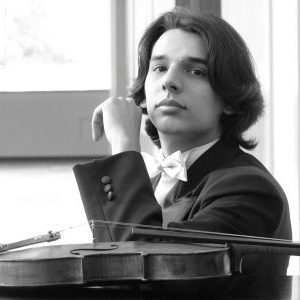
Rafael Torralvo da Silva is a violinist, cultural theorist, and historian of music and sound. His work examines the circulation of knowledge across the Americas and Europe during periods of authoritarian rule. Focusing on Brazil’s military dictatorship (1964–1985), his scholarship investigates how the convergence of vernacular and art music, literature, and media shapes discourses of cultural identity, articulates political dissidence, and redefines notions of citizenship. His research received support from the American Musicological Society’s M. Elizabeth C. Bartlet Fund for Research in France, the Mario Einaudi Center for International Studies, and the Society for the Humanities at Cornell University. He holds a PhD and an MA in music and sound studies from Cornell University and an MM in musicology from the University of Miami. He also earned a BM and an MM in violin performance from James Madison University and West Chester University of Pennsylvania, respectively.
Torralvo da Silva’s current project examines the Armorial Movement, a cultural initiative that sought to create an erudite art form rooted in folk traditions. he argues that sound functions as an epistemological category that challenges historiographies casting the Brazilian Northeast as a culturally and politically regressive region in the context of national modernity. Taking a transhistorical approach, his project foregrounds how artists and intellectuals associated with the Armorial Movement navigated and contested the military regime’s nationalist agenda.